The doorbell has quietly become the most-used piece of technology on the front of a building, and the most mis-sold. In the last year we have been asked to fit a £120 battery doorbell to a six-flat Victorian conversion, and a full multi-tenant entry system to a house that needed neither — both recommendations from suppliers who sell one product and therefore recommend one product. This guide is the conversation we actually have at surveys: what video door entry is, where a video doorbell honestly suffices, and which system fits a single house, a block of flats, or a gated driveway. We install all three kinds, so we have no product to defend — only callbacks to avoid.
Door Entry vs a Video Doorbell — the Difference That Matters
A video doorbell shows you who is at the door. A video door entry system shows you who is there **and releases the door** — from the panel, from a handset, or from your phone anywhere in the world. That one capability changes the hardware completely: a lock release needs an electric strike or maglock in the door frame, wiring to power it, and a system designed to fail safely in a fire. It is the difference between an accessory and building infrastructure, and it is why the two are priced in different leagues. The question that decides everything at a survey is simple: do you ever need to let someone in when you cannot walk to the door? Deliveries to a porch, a cleaner on Tuesdays, an elderly relative, tenants without a concierge — if any of that is your life, you want door entry, not a doorbell.
The Ring Question, Answered Honestly
For a single household that just wants to see callers and talk to the courier, a battery video doorbell is genuinely fine — we say so at surveys and lose small jobs by it. The compromises you accept: no door release, a subscription to keep recorded history (the fee has a habit of rising), battery charging every couple of months, WiFi-dependent latency that means the courier is sometimes gone before the app connects, and footage that lives in someone else’s cloud. None of that is fatal for a doorbell. All of it is disqualifying for door entry — which is why we do not fit battery doorbells to anything with a lock release, a second dwelling, or a gate.
For a Single House: DoorBird, Wired, in the Loxone App
On our residential installations the intercom is almost always a DoorBird: a wired, PoE-powered video door station that puts live view, two-way audio and the unlock button inside the same Loxone app that runs the rest of the house. Wired matters more than any spec-sheet feature — the panel is always on, answers instantly, and never needs a battery charged. Integration matters just as much: because the doorbell press is an event inside the smart home, the house can react. Evening caller? The hallway and porch lights come up as you answer. Nobody home? The press logs a snapshot and the answer happens from a phone in the office, indistinguishable from someone in the kitchen. On our installations the doorbell also rings through the multi-room audio — properly, in whichever rooms are occupied, instead of one chime box under the stairs.
For Flats and Blocks: Paxton Entry
Multi-tenant buildings are a different problem wearing the same faceplate. Six households need individual calling, individual door release, fob access for residents, and — the part landlords learn the hard way — central management when tenants change. Here we install Paxton Entry: a panel at the communal door, monitors or app answering in each flat, and the whole thing running on the same Net2 software as the building’s fob access, so one database controls who gets in by every method. When a tenant moves out, their fob and their app access are revoked in one screen, in seconds, without changing anything for the other five flats. Most of this work in London is replacement — tired analogue intercoms from the eighties where half the handsets are broken — and the good news is that existing riser cabling can often be reused, which keeps the disruption and the making-good to a minimum. One honest nuance: DoorBird also makes multi-button and keypad panels, and on smaller conversions — two to four flats, especially where the flats run their own smart systems — a multi-tenant DoorBird with app answering per flat is often the better fit. The dividing line is management: once a building needs resident fobs, tenant churn handled centrally, and one database for every way in, Paxton on Net2 wins.
For Gated Driveways: the Intercom Is Half the Job
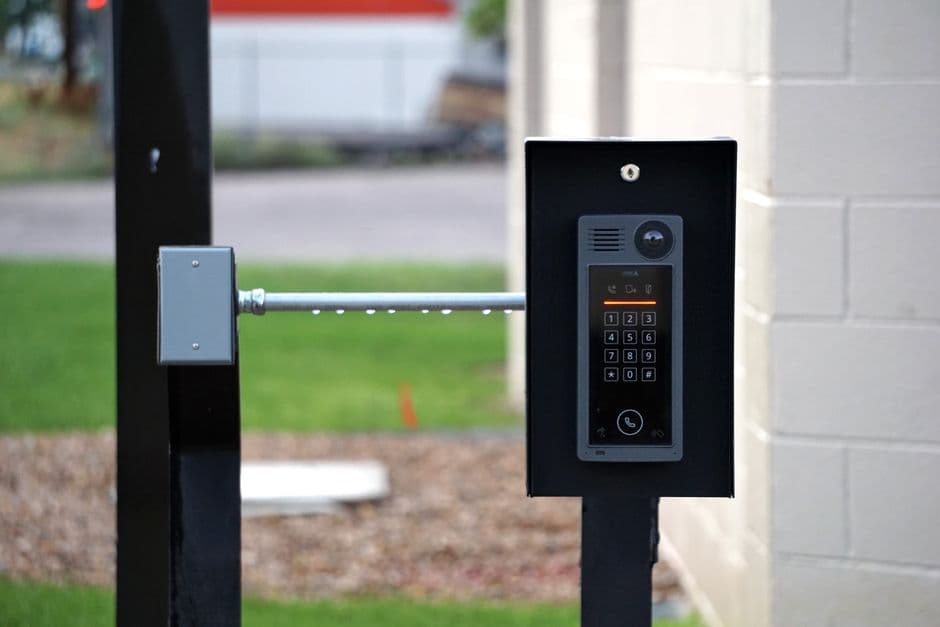
On a gated property the entry system has to release a gate motor, not a door strike — and the difference is everything that surrounds it. The call panel lives on a post at the gate line, cabled back to the house (or linked wirelessly where trenching is genuinely impractical). The gate controller needs interfacing rather than replacing — most accept a simple release signal. Vehicles leaving need a ground loop or free-exit button so nobody fumbles for a fob on the way out, and the whole arrangement must release for fire and emergency access. We cover gates properly on our access control page; the short version is that a gate intercom bought as a gadget and fitted without the electrical and safety thinking is the most common takeover job we see.
What the Camera Sees vs What the CCTV Records
A door station’s camera is for answering the door, not for evidence — wide lens, head-height, great for a face at arm’s length, poor for the street. On installations with CCTV we treat the two as one system: the doorbell press or door release triggers the nearest Hikvision camera to bookmark footage, so the visitor at the panel and the wider scene are both on record. That pairing — intercom for interaction, CCTV for evidence — is the difference between knowing someone called and knowing what they did next.
The Comparison, Straight
| Battery video doorbell | DoorBird + Loxone | Paxton Entry | |
|---|---|---|---|
| Releases the door/gate | No | Yes | Yes |
| Multi-flat calling | No | Yes — multi-button & keypad panels | Yes — built for it |
| Subscription | For recorded history | None | None |
| Power | Battery / doorbell wires | Wired, PoE | Wired, PoE |
| Answer from phone | Yes, cloud latency | Yes, and from wall panels | Yes, per flat |
| House reacts to the press | No | Yes — lights, audio, scenes | Via Net2 events |
| Best for | Seeing callers, renters | Houses, gated homes, smaller conversions | Larger blocks, fob-managed buildings, HMOs |
What Installation Involves, and the Cost Question
For a house: a wired panel at the door, PoE back to the network cabinet, an electric strike or maglock in the frame, and the integration programming — typically a day, two with a gate. For a block: the communal panel, per-flat answering, lock hardware and the Net2 configuration, usually two to four days depending on how much existing cabling survives. On price we hold the same line as everywhere on this site: the honest number comes from a survey, because the door, the frame, the cable route and the gate motor move it far more than the panel’s brochure price does. What we promise is an itemised quote — panel, lock hardware, cabling, programming, each its own line — so you can see where the money goes and strike out anything you do not want. The survey is free across London.
One closing opinion, earned from takeovers: buy the wired system once, or the battery gadget twice. Every spring we remove doorbells whose batteries, subscriptions or discontinued apps outlived their welcome, and fit the wired panel that should have gone in first. The front door deserves infrastructure, not an accessory.
Questions we get asked
What is the difference between a video doorbell and video door entry?
A video doorbell shows you who called and lets you talk to them — but it cannot let them in. A video door entry system adds a controlled lock release on the door or gate, operated from a handset, wall panel or your phone anywhere in the world. The release hardware (electric strike or maglock), its wiring and fire-safe configuration are what separate the two — and why door entry is installed infrastructure rather than a self-fit gadget.
Can a video door entry system unlock the door from my phone?
Yes — that is the point of it. On our house installations, DoorBird puts live video, two-way audio and the unlock button in the Loxone app; on flats, Paxton Entry gives each flat app answering with its own door release. Because these are wired, always-on systems, the call connects in about a second — no waiting for a battery doorbell to wake up while the courier walks away.
Do video door entry systems need a subscription?
The ones we install, no. DoorBird and Paxton Entry both work fully — video calling, door release, visitor snapshots — with no monthly fee, which is consistent with everything else we fit. Battery video doorbells are the opposite: the hardware is cheap and the recorded history sits behind a subscription that tends to rise. Over ten years on a front door, the wired system is usually the cheaper one.
Can you replace the old intercom in our block of flats?
Yes — replacing tired analogue intercoms in London conversions and purpose-built blocks is a large part of our door entry work. We fit a Paxton Entry panel at the communal door with monitors or app answering per flat, and where the existing riser cabling is sound we reuse it, which keeps disruption to communal decoration minimal. Because Entry runs on Net2, the same system manages residents’ fobs — and a departed tenant’s access is revoked in one screen.
Will a video intercom work with my electric gates?
Yes. Gate door entry is standard work for us: the call panel goes on a post at the gate line, we interface with your existing gate motor’s controller rather than replacing it, and vehicles get a free-exit loop or button on the way out. Everything is configured to release safely for fire and emergency access. If the gate motor itself is failing we will say so at the survey — but a working motor never needs to be replaced just to add an intercom.
How much does video door entry installation cost in London?
It depends on the door more than the panel — the lock hardware, the cable route, and whether a gate motor is involved move the figure most, which is why we quote from a free survey rather than a price list. A single-house DoorBird installation is typically a one-day job; a multi-flat Paxton Entry replacement runs two to four days depending on the building. Every quote is itemised line by line, so you can see exactly what each part costs.
Ready to get started?
Free consultation. No obligation.