Building Control · BMS · London & Home Counties
A building management systemwithout the enterprise price.
Heating, cooling, ventilation, lighting, access and energy metering on one locally-processed system — with no per-point licensing, no annual software fees and no cloud dependency. A genuine BMS for the offices, hotels and mixed-use buildings the enterprise vendors don't serve economically.
Why now
Part L now expects buildings to be controlled, not just heated.
Since the 2021 update of Building Regulations Approved Document L, new non-residential buildings in England with heating and air-conditioning output over 290kW must have a building automation and control system — and below that threshold, zoned control and metering are the clear direction of travel. The enterprise BMS vendors are set up for estates and towers. The thousands of small and medium buildings underneath them get a timeclock, a wall of thermostats, and energy bills nobody can explain. That is the gap this page is about.
One System
Six building services,one brain in the plant room.
The point of a BMS is not any single feature — it is that the services stop working against each other. Heating that knows the windows are open. Lighting that knows the floor is empty. Ventilation that responds to the meeting room filling up.
Heating, cooling & ventilation
Zoned climate with schedules, presence and window contacts. Boilers, heat pumps, VRF air conditioning and MVHR coordinated instead of fighting each other.
More detailEnergy management & metering
Consumption metered per floor, zone or tenant. Load management to stay inside supply capacity, and the data to prove savings to a landlord or an auditor.
More detailLighting
Occupancy and daylight-driven lighting across open plan, meeting rooms and circulation — DALI, 0-10V and switched circuits on the same logic.
More detailAccess control
Entry by role and by schedule, with a full audit trail. Doors, gates and barriers on the same system as the alarm and the cameras.
More detailPlant monitoring & alarms
Pump failures, filter pressures, tank levels, frost risk and out-of-range temperatures pushed to the right person before they become a tenant complaint.
More detailCommercial WiFi & networking
Survey-led WiFi for warehouses, offices and retail — scanners that never drop, segregated VLANs, and the cabling backbone the rest of the building runs on.
More detailSecurity & fire interface
Intruder detection, CCTV triggers and fire-alarm interfaces wired into the same brain, so a fire signal releases doors and an alarm event bookmarks footage.
More detailThe Honest Comparison
Siemens and Trend are excellent.They are also built for towers.
If you run a large estate with a dedicated facilities team, an enterprise BMS from Siemens, Trend, Honeywell or Johnson Controls is the right tool, and we will say so at the survey. The problem is everything underneath: per-point licensing, specialist engineering rates and annual software costs mean those platforms rarely make economic sense below several thousand square metres. We install Loxone as the controls layer for exactly those buildings.
No per-point licensing
Enterprise BMS pricing is built around engineering hours and licensed points — every sensor and valve adds software cost. Loxone has no point licences, no annual software fees and no cloud subscription. You buy hardware and commissioning, and then it is yours.
Open protocols, not captive ones
The Miniserver speaks BACnet/IP, Modbus TCP and RTU, KNX, DALI, M-Bus and 0-10V, so it drives the plant you already own — AHUs, chillers, VRF systems, meters — rather than demanding replacement.
Any partner can maintain it
The configuration lives on the Miniserver in your plant room and the software to edit it is a free download. If we fall under a bus, another certified partner opens the config and carries on — no proprietary tools, no ransom on the project file.
Runs without the internet
All logic is processed locally in the building. Broadband down means you lose remote access and nothing else — the heating schedule, the access doors and the alarms carry on.
Who It Is For
The buildings between a shopand a skyscraper.
Offices
Occupancy-driven lighting and HVAC, meeting-room scenes, access by role, and an after-hours mode that actually switches things off.
Office automationMixed-use & residential blocks
Communal heating and lighting, door entry, bin stores, plant rooms and landlord meters — the unglamorous systems that generate the service-charge disputes.
Communal access controlHotels & hospitality
Room-by-room climate that follows occupancy, corridor lighting that never blazes at 3am, and staff-area access on schedules.
Talk to usRetail & leisure
Trading-hours schedules for lighting, heating and signage, CO2-driven ventilation for busy periods, and consumption you can see per site.
Talk to usLight industrial & plant rooms
Process interlocks, tank and pressure monitoring, frost protection and alerting — supervision for the plant nobody looks at until it fails.
Plant monitoringSchools, clinics & studios
CO2-led fresh air where concentration matters, zoned heating for part-occupied buildings, and access that follows the timetable.
Talk to us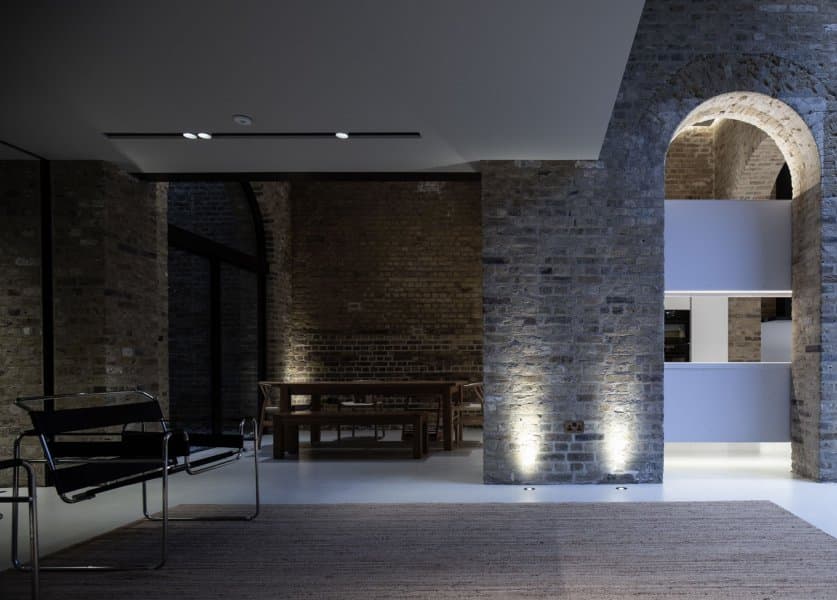
Proof
Station House:a building, not just a home.
Our Station House project is a historic London warehouse conversion — communal entrances, circulation areas, and building services running alongside the private accommodation, all on Loxone. It is the same architecture we install commercially: one controller, zoned services, communal access, and everything visible from one interface.
- Building-wide lighting, heating and shading zones on one Miniserver architecture
- Communal entrance and circulation areas controlled alongside private space
- Local processing throughout — the building does not depend on an internet connection
How It Works
From a walk round the plant roomto a building you can see.
Site survey & points list
We walk the building and the plant room, list what needs controlling and monitoring, and identify what existing kit can stay — most of it usually can.
Design & fixed quote
A system design around the Miniserver with the points list priced item by item — no per-point software licences, no annual fees hiding behind the hardware.
Installation & commissioning
Panels built, field devices wired or integrated over BACnet/Modbus, logic commissioned and tested against how the building actually runs.
Handover & support
Dashboards and alerts configured for your team, documentation handed over, and support from then on — including changes, which do not require a specialist day rate.
Questions
Building management,answered honestly.
What is a building management system (BMS)?
A BMS — also called a building automation and control system (BACS) — is the central system that monitors and controls a building’s services: heating, cooling, ventilation, lighting, metering, and often access and alarms. Instead of each system running on its own timeclock and thermostats, one controller coordinates them against occupancy, schedules and outside conditions, and gives the people running the building one place to see and change everything.
How much does a BMS cost in the UK?
Enterprise BMS projects from the major vendors are typically priced per controlled point, plus engineering time and annual software licensing — which is why they rarely make sense below several thousand square metres. Our Loxone-based systems are priced from the points list with no software licensing at all: a plant room with monitoring and zoned heating control starts in the low thousands, and a full multi-floor office fit-out with HVAC, lighting, access and metering is usually a fraction of an equivalent enterprise quote. We survey first and price item by item, so you can see exactly what each part costs.
Do the Building Regulations require a BMS?
For larger buildings, yes. Since the 2021 update of Approved Document Part L, new non-residential buildings in England with a combined effective rated output for heating and air conditioning (including ventilation) over 290kW must be fitted with a building automation and control system. Even below that threshold, Part L pushes strongly towards zoned control, metering and monitoring — and the payback maths usually justify it regardless of compliance.
Can Loxone really act as a BMS? It is known as a smart home platform.
Yes — the platform is the same, the scale and the field devices change. The Miniserver speaks the commercial protocols (BACnet/IP, Modbus TCP/RTU, KNX, DALI, M-Bus, 0-10V), extensions rack into standard control panels, and the logic engine handles schedules, interlocks, load management and alarming. Loxone is used across commercial buildings in Europe precisely because the licensing model that makes enterprise BMS expensive does not exist here. What it is not: a replacement for an estate-wide Siemens or Trend deployment with a dedicated facilities team — and we will tell you if that is what your building actually needs.
Can you take over or extend an existing BMS?
Often, yes. Where existing plant controllers speak BACnet or Modbus we can integrate them rather than replace them, and where a legacy system is dead or orphaned we can usually reuse the field wiring, valves and sensors — the expensive part of the original install — and replace only the controls layer. The survey establishes what is actually fitted before anything is quoted.
What happens when the internet goes down?
Nothing, operationally. All control logic runs locally on the Miniserver in the building — schedules, climate control, access doors and alarms carry on. You lose remote access and notifications until the connection returns. There is no cloud dependency and no subscription that can lapse.
Which areas do you cover for commercial work?
We are based in Hatch End (HA5) and work across Greater London and the Home Counties. Commercial surveys are free, and takeover enquiries — buildings with orphaned controls nobody can administer — are welcome; it is a significant part of our workload on the access-control side already.
Go Deeper
The detail,service by service.
Heating, cooling & ventilation control
Zoned HVAC, VRF integration, MVHR, plant monitoring and frost protection.
Read itEnergyEnergy management & metering
Per-zone metering, load management, tariff logic and the reporting to prove it.
Read itWorkplaceOffice automation
Occupancy-driven services, meeting-room scenes and after-hours energy mode.
Read itCost GuideWhat a BMS really costs in the UK
How enterprise per-point pricing works, and what a Loxone-based BMS changes.
Read itStart with the survey, not the sales pitch.
We walk the building, list the points, and tell you honestly whether your project needs Loxone, an enterprise platform, or just better schedules on what you already own. Free across London and the Home Counties.