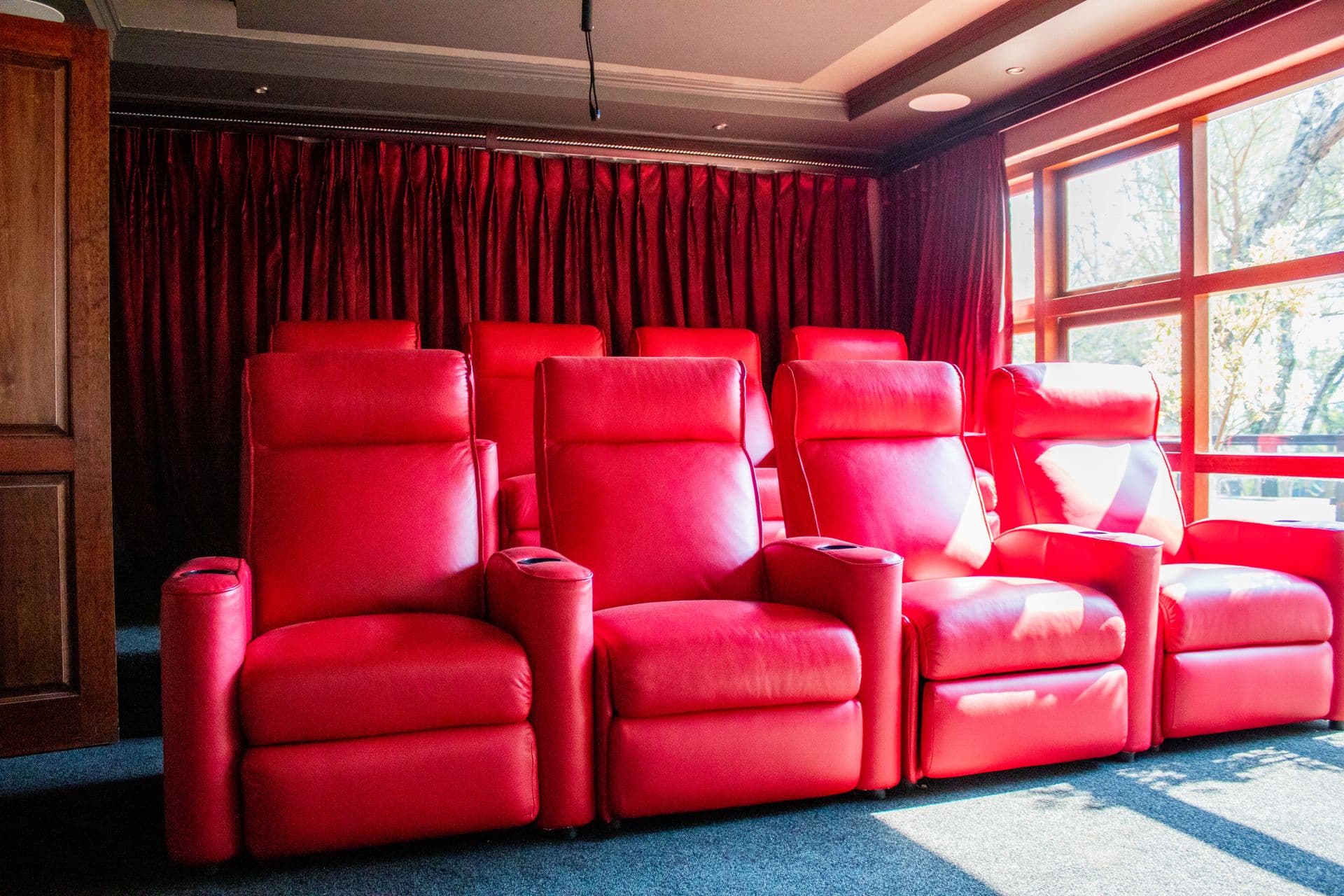
Here is the order most people buy a cinema room in: projector, speakers, amplifier, and then — with whatever budget survives — the seats. It is exactly backwards. Seating positions are the fixed points every other decision hangs from: the screen is sized to the seating distance, the speakers are aimed at ear height at the seats, and a Dolby Atmos layout is literally defined around where heads will be. We are home cinema installers, not a furniture shop — we do not sell a single chair — which makes this a rare thing in cinema-seating articles: advice from someone with no chairs to shift.
Seats First, Everything Second
When we design a room, the seating plan is drawn before the equipment list exists. Where the seats go determines the viewing distance; the viewing distance determines the screen size; the screen position determines where the three front speakers and the ceiling speakers land. Buy the recliners after the projector and you end up compromising the £8,000 system around a sofa that arrived a foot too deep. Decide the seats first — even just their positions, before the specific model — and everything else falls into place cheaper.
Recliners, Sofas, or Both
Dedicated cinema recliners are built for the job: high backs that do not block the row behind, motorised recline that does not require shuffling the whole seat, and arms that hold a drink through an action sequence. They are also, without exception, enormous — a two-seat recliner unit runs around 1.7m wide and needs the best part of 1.6m front-to-back when reclined. In London rooms that maths is brutal, which is why our most common specification is a hybrid: a deep, high-backed sofa as the main row for family viewing, and two recliners where the enthusiasts sit. The sofa keeps the room human; the recliners keep the enthusiasts happy. What we counsel against is the ordinary living-room sofa in a dedicated room — low backs put heads below ideal ear height for the calibrated speakers, and squashy cushions have people slumping out of the soundstage twenty minutes in.
The Measurements That Matter
These are the numbers we actually lay out with a tape measure at surveys. Eye height from floor, seated: roughly 1.0-1.1m, which is what the screen centre should sit near — the most common DIY error we correct is a screen mounted a foot too high, because it looked right standing up. Viewing distance: about 1.2 times the screen’s diagonal for an immersive seat on a 4K picture — around 3.4m for a 110-inch screen. Row spacing, if you have depth for two rows: 1.5m minimum between row fronts, more if the front row reclines. Riser height for the second row: 300mm is the working figure for a typical room, built as a proper platform with step lighting, not a stage of loose boxes. And walkway: 600mm minimum to get past a row without a shuffle-apology.
| Measurement | Working figure | Why it matters |
|---|---|---|
| Screen centre height | ~1.0-1.1m (seated eye height) | Necks last a three-hour film |
| Viewing distance | ~1.2 x screen diagonal | Immersion without pixel-hunting |
| Row spacing | 1.5m+ front to front | Recline room, pass-through |
| Riser height | ~300mm second row | Clear sightline over row one |
| Walkway | 600mm minimum | Mid-film exits without theatre |
The Second Row Question
Everyone wants two rows; not every room has earned them. The honest threshold is about 5.5m of room depth — below that, the second row either sits against the back wall (the worst bass in the room, boomy and uneven) or crushes the first row’s recline. If the room is shorter, one generous row beats two mean ones, and a couple of bar-height stools or beanbags behind for big-match nights covers the overflow without pretending to be a row. If the room is long enough, build the riser properly: platform construction, carpet over, low-level step lights on their own dim circuit — that last detail is the difference between a cinema and a trip hazard.
Power, Cables, and the Things Under the Floor
Modern cinema seating is electrical: motorised recline, USB charging, occasionally heated seats. Every powered seat needs a socket it can reach without an extension lead crossing a walkway — which means floor boxes or sockets planned at first fix, before carpets. This is the single most common thing we are asked to fix after the fact, and retrofitting a floor box under a fitted carpet in a finished room is exactly as tedious as it sounds. While the floor is open we also run a data point to the seating position; a tactile transducer (a bass shaker bolted to the riser — silly name, tremendous fun) needs signal and power, and even if you do not want one now, the cable costs pennies at first fix.
Fabric, Leather, and the Acoustic Detail Nobody Mentions
Seats are acoustic objects. A big leather recliner reflects treble; fabric absorbs it; and a room seated entirely in leather sounds measurably brighter than the same room in fabric. It is not a reason to avoid leather — it is a reason to tell your installer before calibration, not after the seats arrive. Fabric also wins on the practical fronts (quieter when you move, no peeling in a warm dark room full of electronics), while leather wins on spilt-drink nights. Families with young children already know which side of that trade they live on.
Where the Scene Ties It Together
On our installations the seating is wired into the room’s logic like everything else. The Cinema scene drops the lights and closes the blinds; pause lifts the step lights so the popcorn run is safe; end of film brings the room gently back. Because the whole thing runs on Loxone locally, there is no cloud service between the pause button and the lights — it just works, at the speed a light switch works. Seating is where you will spend three hours at a time; the room responding around it is what makes those hours feel like cinema rather than furniture. If you are planning a room, the design visit is free — bring the room dimensions and we will bring the tape-measure numbers above.
Questions we get asked
What is the best seating for a home cinema?
For a dedicated room: purpose-made cinema recliners or a high-backed, firm sofa — the high back matters because your head should sit at the ear height the speakers were calibrated to. Our most common specification is a hybrid: a quality sofa as the main row and a pair of recliners for the enthusiasts. Ordinary low-backed living room sofas are the weakest choice in a dedicated room, though they are perfectly fine in a living-room media room.
How far should seats be from the screen?
A good working figure for 4K is about 1.2 times the screen diagonal — roughly 3.4m for a 110-inch screen. Closer is more immersive but risks visible artefacts on poor sources; further starts to feel like watching a television. This is why we fix the seating distance first and size the screen to it rather than buying the biggest screen the wall can carry.
How high should a riser be for a second row of cinema seats?
Around 300mm for a typical domestic room — enough for the second row to see over reclined front-row heads without their own heads pressing against the ceiling of a standard-height room. It should be a properly built platform with a 1.5m-plus gap to the front row and low-level step lighting on its own circuit. A second row is only worth building if the room has roughly 5.5m of depth or more.
Do cinema recliners need power?
Motorised ones do, and so do USB chargers and heated seats — each powered seat needs a socket within its footprint, which means floor boxes planned before carpets go down. This is the most common retrofit we are called back for, and the cheapest thing to get right at first fix. We run a data point to the seating position at the same time for tactile transducers and future upgrades.
Does leather or fabric seating sound different in a cinema room?
Genuinely, yes. Leather reflects high frequencies and fabric absorbs them, so an all-leather room measures and sounds brighter than the same room in fabric. Neither is wrong — but the seats should be chosen (or at least declared) before the system is calibrated, because calibration compensates for the room as furnished, seats included.
Ready to get started?
Free consultation. No obligation.