Energy Autopilot · Home Energy Management
Your home, spending lesson energy. Automatically.
A home energy management system connects your solar panels, battery, EV charger and heat pump into one brain with one job: use electricity when it's cheapest — or free from your own roof. You do nothing. The house decides, half-hour by half-hour.
Runs locally on Loxone. No subscription, ever. Installed across London and the Home Counties by certified engineers with our own electrical team.
Solar
your roof
Grid
30-min prices
Loxone Miniserver
decides in real time
Battery
Hot water
EV
Cheapest source wins — automatically, all day
01 · The Problem
Your energy kit doesn't talk to itself.
Solar panels, a home battery, an EV charger, maybe a heat pump — each one excellent, each one sold separately, each one running its own logic in its own app. The result is quietly absurd: your panels export electricity to the grid for pennies at noon, and your car buys electricity back at peak rates at 6pm.
Meanwhile you're on a tariff where prices change every half hour, and nothing in the house pays any attention. The apps tell you what you spent — after you've spent it. Monitoring is not managing.
A normal Tuesday
- Solar exported to the grid at noon — for pennies
- Car plugged in at 6pm, charging at the day’s peak rate
- Water heated on a timer, blind to the price
- Four apps reporting what you already spent
The same Tuesday, on Autopilot
- Solar surplus routed to hot water, then the battery
- Car charged overnight in the cheapest half-hours
- House pre-heated in the cheap window, coasted through the peak
- One system decided everything — you did nothing
“Monitoring is not managing. An app that reports what you spent is not a system that spends less.”
The Energy Autopilot principle
02 · What It Does
One brain, four jobs.
The Loxone Miniserver watches generation, storage, prices and your routines in real time — and moves energy to wherever it's worth most.
Solar surplus goes to work
When the roof produces more than the house is using, the surplus is routed by priority: charge the battery, heat the water, top up the car — instead of being exported for a fraction of what you paid this morning. Typical self-consumption jumps dramatically once something intelligent is deciding.
Smart EV charging
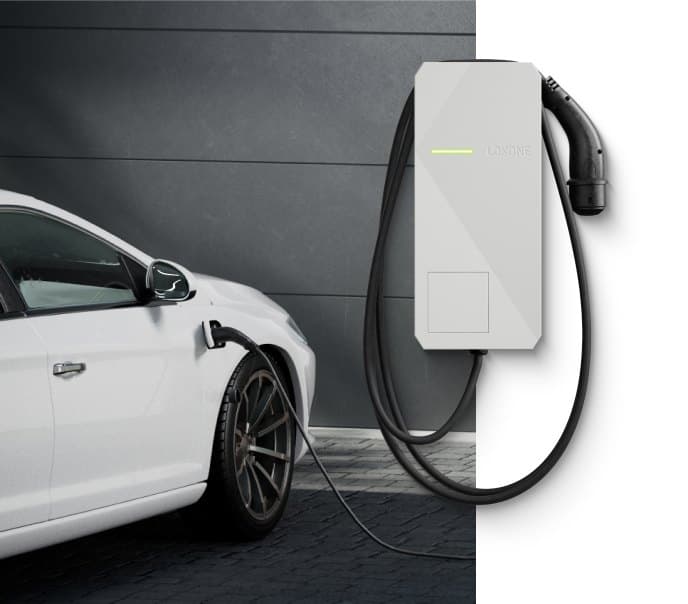
The wallbox modulates charging power to match your live solar surplus — the car literally fills with sunshine. Need it full by 7am regardless? It schedules the remainder into the cheapest overnight window on your tariff. Per-journey priority: cheapest, fastest, or greenest.
Heating that reads the price
On dynamic tariffs like Octopus Agile, the system pre-heats water and rooms during the cheap half-hours and coasts through the expensive ones — comfort unchanged, cost noticeably not. Heat pumps and immersion heaters become schedulable assets instead of dumb loads.
One live picture of everything
Generation, storage, consumption, import and export — one dashboard in one app, updating live. Not a monthly report of money already gone: a system you can watch making decisions, and override with a tap when life changes.
03 · The Numbers
Buy low. Use free. Skip the peak.
On a dynamic tariff, the price of electricity changes every half hour. This is what a typical day looks like — and where your house acts while you're not watching.
Electricity price over 24 hours
01:30 — car and battery charge in the cheapest half-hours
13:00 — solar surplus heats the water for free
17:30 — peak prices; the house coasts on battery and pre-heat
£300–390
saved per year
From tariff optimisation alone — BCG 2025 analysis, detached home with heat pump, battery and EV.
40%
potential energy saving
Loxone studies, when lighting, shading, heating and energy run as one system.
£0/mo
forever
No subscription. Runs locally in your house — and keeps working if the internet doesn't.
We're deliberately conservative with promises — your number depends on your tariff, your hardware and how you live. At the survey we walk your actual bills and give you a realistic figure, not a brochure one.
04 · Your Hardware
Works with what you have. Ready for what you'll add.
Loxone integrates directly with the common inverters, batteries, wallboxes and smart meters — and speaks Modbus, HTTP and the other standard protocols for everything else. Already have solar from one company and a charger from another? That's the normal case, and it's exactly the problem this solves.
Starting from zero? Our own electrical team installs EV chargers and works alongside your solar installer, so one company is accountable for the whole chain — and if you add a battery or heat pump in two years, the system simply starts managing it. No reconfiguration, no new app.
Energy Autopilot is one of eight features the same Loxone system can run — most clients pair it with whole-home automation during a renovation, when installation costs drop sharply. Comparing platforms first? Energy coordination like this is native to Loxone and an add-on elsewhere — see our Loxone vs Control4 vs Crestron verdict.
What it coordinates
Plus anything speaking Modbus or HTTP — most professional-grade kit qualifies.
05 · Questions, Answered
Home energy management FAQs
What is a home energy management system (HEMS)?+
A home energy management system is a controller that coordinates everything in your house that generates, stores or uses significant electricity — solar panels, battery storage, EV charger, heat pump, immersion heater and large appliances. Instead of each device following its own logic, the HEMS decides in real time where energy should flow: use solar surplus now, store it, or charge the car with it. In our installations that brain is the Loxone Miniserver, which runs everything locally in your house with no subscription.
Can it charge my EV from solar panels only?+
Yes — this is one of the most popular functions. The system measures your solar surplus moment to moment and adjusts the car’s charging power to match it, so the battery fills with sunshine rather than grid electricity. If you need the car ready by a set time regardless, it tops up the remainder during the cheapest tariff window overnight. You choose the priority (cost, speed, or green-only) per journey in the app.
Does it work with Octopus Agile and other dynamic tariffs?+
Yes. With a dynamic tariff, electricity prices change every half hour — and the system schedules flexible loads (EV charging, water heating, heat pump pre-heating, battery charging) into the cheapest windows automatically. Analysis by Boston Consulting Group in 2025 put achievable savings from dynamic-tariff optimisation alone at roughly £300–£390 per year for a detached home with a heat pump and an EV, before any solar is added.
Is it worth it if I don’t have solar panels?+
Often, yes — tariff optimisation works without any solar: the system heats water, pre-warms the house and charges the car when electricity is cheapest. And because the infrastructure is then in place, adding solar or a battery later needs no reconfiguration — the system simply starts using them. Many clients phase it exactly this way.
Which solar inverters, batteries and EV chargers does it work with?+
Loxone integrates directly with the common inverter, battery and wallbox brands, plus smart meters — and the Miniserver also speaks Modbus, HTTP and other standard protocols, so a competent integrator can bring in most professional-grade kit. If you already own hardware, we check compatibility during the survey; if you’re buying new, we’ll recommend combinations we’ve commissioned before. Our own electrical arm installs EV chargers, so one team handles the whole chain.
Is there a subscription for the energy management features?+
No. This is a core Loxone difference: the energy management runs locally on hardware you own. The app, remote access, energy dashboards and firmware updates are free for the life of the system. Nothing sits behind a monthly fee.
How much does a home energy management system cost in the UK?+
As a standalone installation into an existing home, Energy Autopilot typically starts around £4,500 installed and programmed, depending on what it needs to coordinate. Added during a renovation, rewire or new build — or on top of an existing Loxone system — it costs significantly less. A discovery call gives you a realistic figure in 15 minutes.

Fifteen minutes. A realistic number.
Tell us what you have — solar, battery, EV, heat pump, or none of it yet — and we'll tell you honestly what Energy Autopilot would save in your house, and what it would cost.